
That little amber engine symbol has a way of showing up at the worst time. It might be something simple, or it might be your car’s early warning that something needs attention. At Xpress Automotive, we help drivers in Ahwatukee and across Phoenix find out exactly why the light is on, so you can make a clear, informed decision about what to do next.
What the Check Engine Light Means
Since 1996, cars and light trucks sold in the U.S. have come with an on-board diagnostic (OBD II) system that monitors the engine, transmission, and emissions equipment. When it detects a problem, it stores a trouble code and turns on the “Check Engine” light, which the U.S. EPA calls the Malfunction Indicator Light. Some vehicles display it as “Service Engine Soon.”
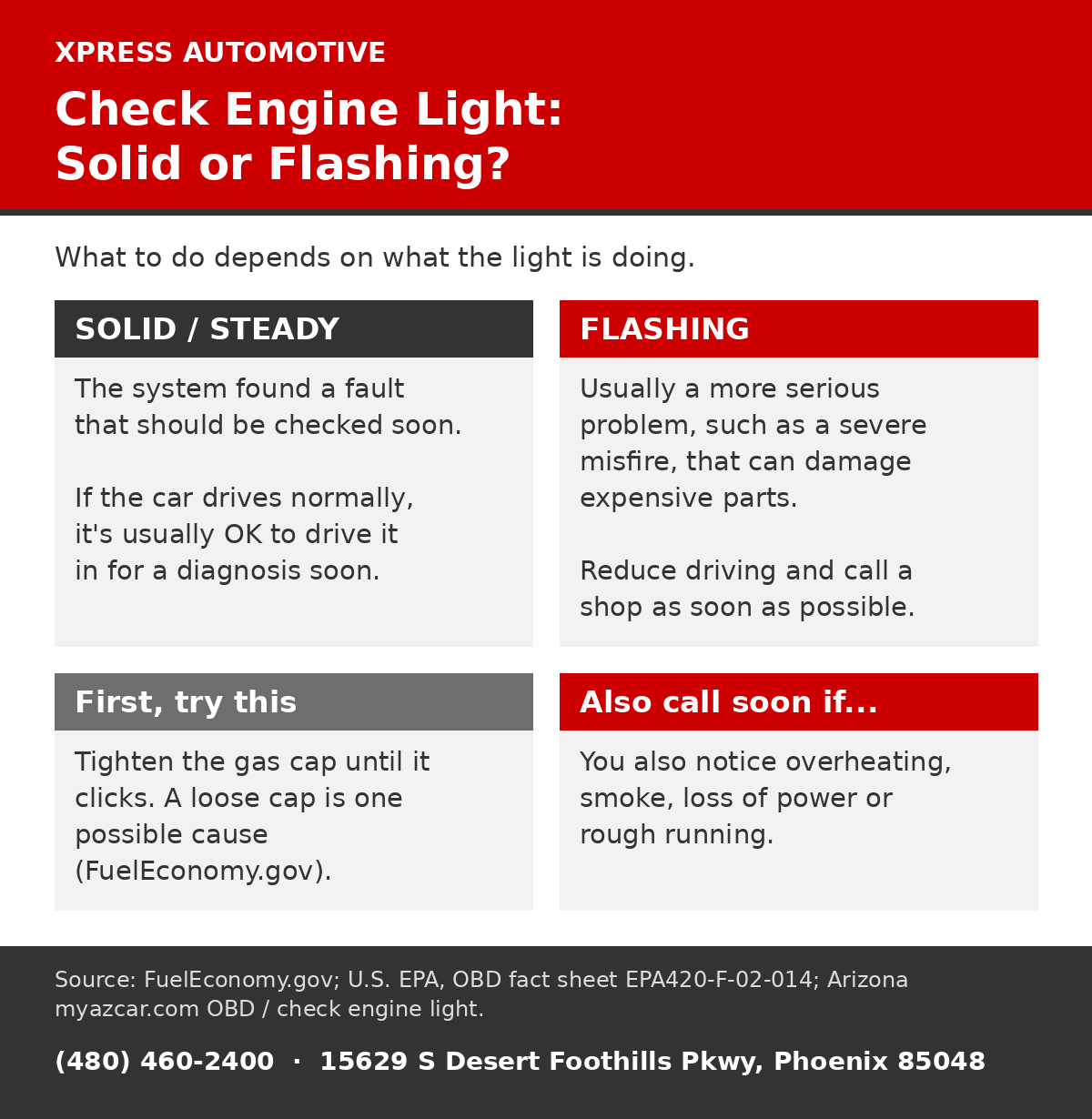
A steady light means the system found a fault that should be checked soon. A flashing light usually signals a more serious problem, such as a severe misfire, that can damage expensive parts if you keep driving. If yours is flashing, reduce driving and call us as soon as possible.
Common Reasons the Light Comes On
- A loose, damaged, or missing gas cap
- A failing oxygen sensor
- Worn spark plugs or ignition coils, or bad spark plug wires
- Catalytic converter problems
- Mass airflow sensor issues
- Vacuum or evaporative-system leaks
- Engine running too hot or a faulty thermostat
According to FuelEconomy.gov, the cause “could be something as minor as a loose gas cap, but it could also be a more serious issue that could reduce your fuel economy, increase emissions, and/or lead to costly repairs later.”
Why You Shouldn’t Ignore It
Small problems found early tend to stay small. The EPA notes that by identifying a relatively inexpensive repair, like replacing a malfunctioning oxygen sensor, OBD can save the owner the cost of replacing the catalytic converter later.
In Arizona, there’s another reason to act. According to myAZcar.com, the state’s emissions program, 1996 and newer vehicles cannot pass emissions testing with the check engine light illuminated. If your test is coming up, it’s best to get the light diagnosed and repaired first.
How We Diagnose a Check Engine Light
Reading a code is only the first step. A code tells us which system reported a problem, not always which part is to blame. Here’s how we approach it:
- Listen first. We ask what you’ve noticed: when the light came on, and whether the car runs, sounds, or smells different.
- Scan the system. We retrieve the stored trouble codes and related data from your car’s computer.
- Test, don’t guess. We check the components and systems connected to the code to confirm the actual cause.
- Explain your options. We walk you through what we found and give you a detailed estimate before any repair work begins.
This page focuses on the check engine light. For other dashboard warnings and electronic issues, see our full diagnostic services. If the problem turns out to be electrical, our electrical service team can help, and for internal engine problems we offer engine repair.
What You Can Do Before Your Visit
- Check that your gas cap is tight and clicks into place
- Note whether the light is steady or flashing
- Watch your temperature gauge; if it climbs, pull over safely
- Write down any new noises, smells, or changes in how the car drives
What’s Different at Xpress Automotive
A code tells us where to start, not what to replace. We look for the actual cause before recommending a repair, and we’ll walk you through what we found. As Rima at Xpress puts it: the team is “fully up to date with classes and training.” You’ll find us at 15629 S Desert Foothills Pkwy in Ahwatukee, open Monday through Friday, 8:00 a.m. to 4:30 p.m., and closed Saturday and Sunday. Call (480) 460-2400.
Frequently Asked Questions
Is it safe to drive with the check engine light on?
If the light is steady and the car drives normally, it’s usually OK to drive it in for a diagnosis soon. If the light is flashing, or you notice overheating, smoke, loss of power, or rough running, reduce driving and call us as soon as possible. Waiting can turn a small repair into a bigger one.
Can a loose gas cap turn on the check engine light?
Yes. FuelEconomy.gov notes it could be something as minor as a loose gas cap. Tighten the cap until it clicks. If the light stays on after a few drives, have it checked.
Will my car pass the Arizona emissions test with the check engine light on?
No. According to Arizona’s emissions program, 1996 and newer vehicles cannot pass emissions testing with the check engine light illuminated. Get it diagnosed and repaired before your test.
Can I just clear the code with a scanner?
Clearing a code turns the light off but doesn’t fix the problem, and the light will usually come back. Clearing codes also resets your car’s readiness monitors, which need to be ready for an Arizona OBD emissions test.
Is reading the code the same as a diagnosis?
No. A code tells you which system reported a problem, not always which part failed. We use the code as a starting point, then test to confirm the cause before recommending a repair.
Get Your Check Engine Light Checked
Don’t let a warning light linger. Call us at (480) 460-2400 or book your appointment online. We’re at 15629 S Desert Foothills Pkwy, Phoenix, AZ 85048, open Monday through Friday, 8:00 a.m. to 4:30 p.m.